
Data breach incident response plans prepare your company to deal with cyberattacks successfully. These plans involve a complete set of procedures to identify, contain, investigate, and recover after data breaches. Having a documented data breach response plan before a problem arises is paramount to preventing revenue loss, reputational damage, and legal issues.
Small and medium-sized businesses (SMBs) are often attacked because they store large amounts of sensitive data and have fewer resources to protect it than large companies. This makes them an easier target for cyber criminals.
A data breach incident response plan helps businesses reduce financial losses, minimize downtime, meet regulatory compliance, and protect customer trust following a security incident. Protect your business operations from the very real threat of a cyberattack and the negative business impacts that follow:
- Revenue loss
- Operational disruption
- Legal liability
- Regulatory fines
- Reputational damage
- Loss of customer trust
The purpose of a data breach incident response plan is to provide a strategy that helps the business minimize damage, reduce recovery time, and limit harm. It establishes clear protocols to contain and remediate cyber incidents in a timely and unified way.
What Should Be Included in a Data Breach Response Plan?
Each data breach incident response plan should clearly define roles, procedures, and lines of communication.This plan involves many employees and spans different departments. It is critical to be clear in your directions. Include all aspects of the recovery process in your incident response plan:
- Incident response team members
- Escalation procedures
- Communication plans
- Contact information
- Regulatory requirements
- Backup and recovery procedures
- Vendor and cyber insurance contacts
- Documentation requirements
The data breach response plan should include space to note your findings throughout the recovery process and fill in a post-incident review. This information will help your company prevent and respond better to data breach incidents in the future.
Questions a Data Breach Response Plan Should Answer
Effective data breach incident response plans eliminate uncertainty by answering important operational questions before a breach occurs.
- Who is in charge of the response?
- Who approves notifications?
- How are incidents classified?
- How and when are clients notified?
- How are backups restored?
Start the process by running through one of the most popular cybersecurity risk assessment templates to identify current risks in your company’s infrastructure. Then, work with a professional incident response services team to implement a comprehensive data breach incident response plan based on current cybersecurity trends and cutting-edge solutions.
Data Breach Incident Response Plan Phases
The data breach incident response planning process involves six phases.
Phase 1: Preparation
The first phase involves identifying the people, tools, policies, and procedures needed to respond effectively to a data breach before it occurs.
Consider who will be on your data breach response team, and which procedures are best suited to your response plan. The preparation phase should include all aspects of people, assets, strategies, and communication, including:
- Incident response team creation
- Role assignments
- Security tools and monitoring systems
- Asset inventories (information, software, and hardware)
- Access controls
- Backup strategies
- Employee training
Write clearly and establish formal policies at this stage to ensure the subsequent phases are successful.
Phase 2: Detection and Identification
The detection phase involves identifying potential security incidents quickly enough to prevent further damage. Security team members must keep tabs on:
- Monitoring systems
- Security information and event management (SIEM) software alerts
- Endpoint detection and response (EDR) system alerts
- User reports
- Log analysis
Signs of potential threats and compromise should be carefully monitored and reported. Look for unusual login activity, unauthorized file access, unexpected data transfers, and indicators of ransomware. These indicators include pop-up messages demanding payment or suddenly losing access to files or a device.
Phase 3: Containment
The containment phase focuses on stopping the breach from spreading while preserving evidence for further investigation.This phase of your data breach incident response plan should cover the immediate actions required for containment, as well as short- and long-term containment plans.
Immediate Containment Actions
Immediate containment actions isolate affected systems to stop the data breach and minimize damage. Coordinated actions should include:
- Isolating the affected systems
- Segmenting networks
- Physically disconnecting devices from the network
- Blocking malicious IP addresses at the firewall
- Disabling compromised accounts
Short-Term Containment
Short-term containment is closely tied to immediate containment. Damage minimization is still prioritized over operational continuity.
Temporary security controls are put in place during the short-term containment phase. These allow security teams to protect critical assets while they prepare to continue business operations.
Important: Preserve forensic evidence from the data breach for future investigations.
Long-Term Containment
Long-term containment involves establishing procedures that allow the business to resume operations safely. Permanent remediation plans involve finding and clearing the root cause of the security incident.
- Infrastructure hardening is often used to reduce the attack surface. This involves removing unnecessary services and enforcing secure access controls through networks, applications, and resources.
- Vulnerability mitigation involves implementing controls that minimize the likelihood of an asset being exploited. This acts as an interim safeguard if a permanent fix is not yet ready.
Data Breach Notification Requirements
Notifications are part of the long-term containment phase. Many businesses are required to notify clients after a data breach.
Find out which state breach notification laws, industry regulations, and timelines you are subject to before a data breach occurs. These include HIPAA, PCI DSS, contractual obligations, and state data privacy laws.
Data Breach Letter Notification Template
Subject: Important Notice Regarding a Data Security Incident
Dear [Customer Name],
We are writing to let you know about a data security incident that may have involved some of your personal information.
On [Date], we identified unauthorized access to certain systems. When the breach was detected, we immediately took steps to contain it and launched an investigation with cybersecurity professionals.
The information potentially involved includes: [Types of Information].
At this time, there is no evidence of misuse. However, we recommend monitoring your accounts and remaining alert for suspicious activity.
We have implemented additional security measures to strengthen our systems and reduce future risk.
If you have questions, please contact us at [Phone Number] or [Email Address].
Sincerely,
[Company Name]
Phase 4: Eradication
Eradication removes the root cause of the cyber incident and other threats from the environment. This may include:
- Removing malware
- Remediating vulnerabilities
- Auditing accounts
- Securing networks, endpoints, and passwords
- Applying security patches
- Remediating third-party compromise
Phase 5: Recovery
The recovery phase involves restoring company-wide systems safely while making sure attackers do not have access. During this phase, companies get critical networks back online, coordinate with vendors, continue customer communications, and start to rebuild. It’s critical to keep monitoring your IT systems, scanning for vulnerabilities, and hunting for threats to check that the fixes are working and prevent another incident.
Phase 6: Post-Incident Review
Each incident offers valuable feedback that should be used to reinforce future security goals. The post-incident review should include:
- Root cause analysis
- Timeline reconstruction
- Team performance reviews
- Documentation updates
- Process improvements
This information will help your company strengthen its data breach incident response plan and handle these kinds of events even more effectively in the future.
Continuous improvement is necessary for responding more effectively to data breach incidents in the future. Be disciplined with annual testing and post-incident feedback, and update your data breach incident response plan as you go to ensure it’s always ready for action.
Data Breach Incident Response Plan Example
This simplified example shows how response phases work together during an incident. Make sure your employees are familiar with the general flow.
- An employee clicks on a phishing email.
- The employee’s credentials are stolen.
- Unauthorized access is detected.
- Containment is initiated.
- Notifications are completed.
- Systems are restored.
- Policies are updated.
Data Breach Incident Response Plan Checklist
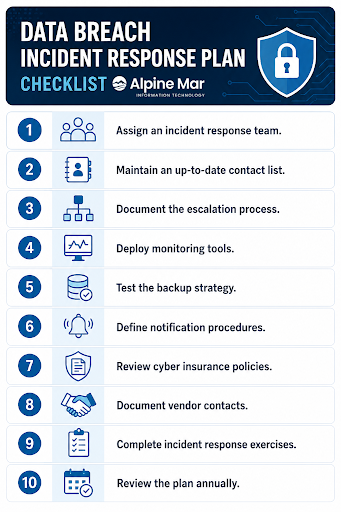
Use this data breach incident response plan checklist to make sure your business is ready to respond clearly and decisively to the next security incident.
- Assign an incident response team.
- Maintain an up-to-date contact list.
- Document the escalation process.
- Deploy monitoring tools.
- Test the backup strategy.
- Define notification procedures.
- Review cyber insurance policies.
- Document vendor contacts.
- Complete incident response exercises.
- Review the plan annually.
Data Breach Preparedness Best Practices
Businesses that prepare correctly for a data breach have a better chance of recovering quickly and suffering fewer setbacks post-incident.Implementing these best practices puts your business one step closer to a fast and successful recovery.
- Implement multi-factor authentication across the business immediately.
- Make offline backups of business data daily to weekly.
- Apply security patches within 24 to 72 hours of release.
- Provide security awareness training to employees upon onboarding and then every four to six months. They should know how to look for phishing emails, protect their credentials, and avoid errors.
- Conduct access reviews quarterly.
- Perform vendor risk assessments regularly, based on the level of risk. Every six to 12 months for high-risk vendors, every 18 to 24 months for medium-risk vendors, and every two to three years for low-risk vendors.
- Perform incident response drills at least annually.
FAQ
What are the most common causes of data breaches?
Most data breaches result from:
- Human error
- Stolen credentials
- Weak passwords
- Phishing attacks
- Ransomware
- Insider threats
- Patching vulnerabilities
What happens if a business fails to report a data breach?
Failure to report a data breach exposes businesses to potentially severe reputational, financial, and legal consequences.
Who should be on an incident response team?
An incident response team should include core leadership and technical experts, along with support functions, like a communication manager and a legal representative.
Prepare for a Fast, Unified Data Breach Incident Response
Preparation matters when it comes to incident response. One in four businesses is hacked despite cybersecurity measures. Make sure your business is ready for a data breach with a robust incident response plan.
The containment and recovery phases are extremely important, but don’t skimp on the preparation phase. A thoughtful start will help you produce a solid plan that’s ready for any cyber incident that comes your way.